How to make a value scale with a pencil
Draw five boxes in a row. Leave the first as white paper, fill the last as dark as you can, and fill the three between them in even steps. While you draw, give each area a number from 1 to 5 and compare it with the scale. Squint to see the big tones: the details blur away and a few flat shapes remain.
On this page: The value scale · Squinting
The value scale
Five tones are enough for most drawings. Making a scale once teaches your hand how hard to press for each.
- Draw five boxes in a row on the edge of your paper.
- Leave the first one as paper, fill the last one as dark as you can, then fill the three between them in even steps.
- While drawing, give each area a number from 1 to 5 and compare it with your scale.
Used in: a die (Step 6).
Squinting
Detail hides the big tones. Squint and the small things blur away, leaving a few flat shapes of light and dark.
- Narrow your eyes until the picture goes blurry.
- Find three groups: the lightest areas, the middle grey and the darkest.
- Draw those three shapes first. Details come later, inside them.
Used in: a pear (Step 6), a mushroom (Step 6), a seashell (Step 6), a Turkish coffee pot (Step 6), a Turkish tea glass (Step 6).
Practise it in a drawing
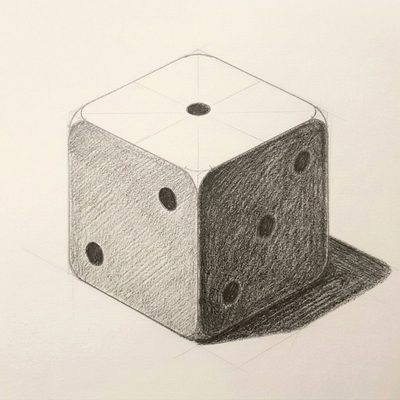 How to draw a die
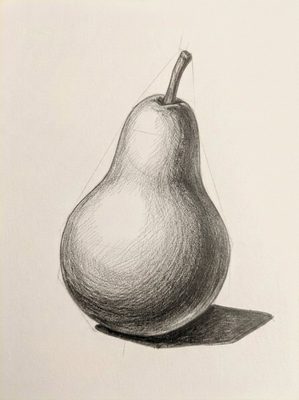 How to draw a pear
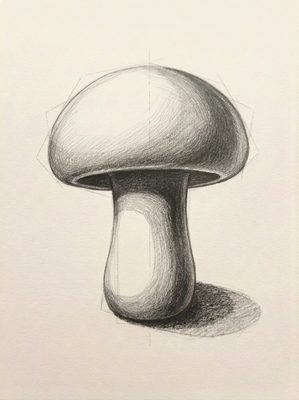 How to draw a mushroom
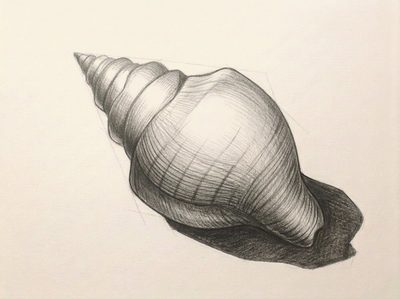 How to draw a seashell
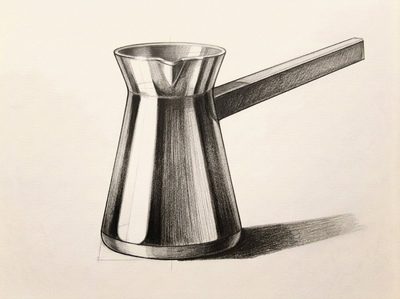 How to draw a Turkish coffee pot
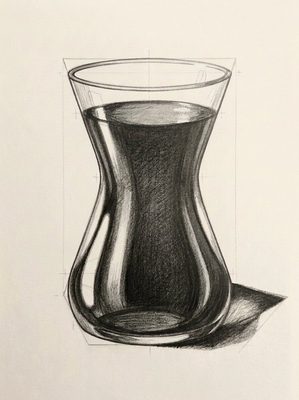 How to draw a Turkish tea glass
More techniques
- Pencil grades: 2H, HB, 2B and 4B, and when to use each
- Light and shadow: core shadow, cast shadow and reflected light
- Hatching, cross-hatching and smooth tones
- How to measure proportions with a pencil
- How to draw ellipses and clear glass
- One-point and two-point perspective
- Erasing, cleaning up and lifting highlights
In Lapis, a technique card opens in the Lesson that first needs it, next to your paper, and stays on your Techniques shelf. You draw freehand with a real pencil; one tap to the next Step.
Get Lapis on the App Store